Paid opportunity to gain community health training
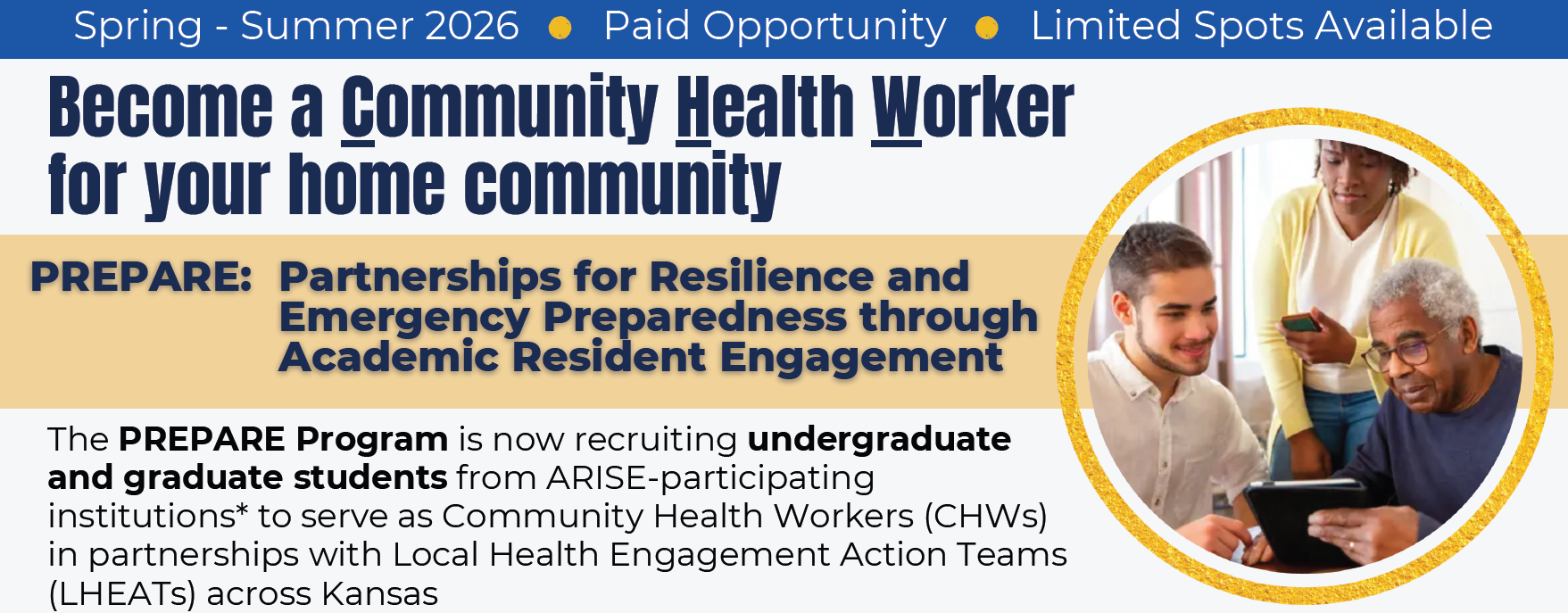
This spring and summer, Kansas college students are invited to apply to the new PREPARE program, which stands for Partnerships for Resilience and Emergency Preparedness through Academic Resident Engagement.
Through PREPARE, 10 students will gain training and a chance to serve as Community Health Workers in their hometowns. Christina Pacheco, assistant professor at the University of Kansas Medical Center, leads the program with funding from a Research and Education Innovation Award from the ARISE project.
This is a paid opportunity that includes:
- $2,000 stipend for the student to cover their training and engagement
- $2,000 in project implementation funds for the LHEAT (Local Health Equity Action Team) and student to implement a locally designed emergency preparedness/disaster response pilot project
- 20-hour virtual (mostly asynchronous) CHW “Quick Start” training
- LHEAT orientation and structured engagement
Applications will be reviewed on a rolling basis, but space is capped at 10 students; so earlier applications are strongly encouraged. Apply now!
To be eligible, students must be:
- Enrolled (undergraduate or graduate) at an ARISE partner institution:
- University of Kansas/KU Med Center, Kansas State University, Wichita State University, Baker University, Emporia State University, Donnelly College, Butler Community College, Johnson County Community College, Kansas City Kansas Community College, Barton Community College, Dodge City Community College, Garden City Community College, and Seward County Community College, Benedictine College, Bethany College, Fort Scott Community College, Friends University, or McPherson College
- Originally from or living in Seward, Finney, Ford, Johnson, Wyandotte, or an adjacent county
- If from an adjacent county, they must be willing to serve on an LHEAT in one of the ARISE counties
- Able to complete the 20-hour virtual CHW training
- Commit approximately 50 total hours to the program
- Join and actively engage with their home LHEAT
- Partner with the LHEAT over the summer to co-design and implement a small-scale emergency preparedness/disaster response pilot project
This initiative is about building local capacity and strengthening place-based leadership in emergency preparedness.