How a Tabletop Role-Playing Game Teaches Resiliency
A Wichita State University group teams up with museum staff at the University of Kansas to bridge the gap between infrastructure research and practice with a new role-playing game for all ages.
"When you say the words 'environmental finance' everybody’s eyes glaze over. Which I get," said Tonya Bronleewe, director of WSU’s Environmental Finance Center (EFC).
But finances are the lifeblood of every town and city, especially when related to infrastructure and the environment.
Bronleewe and her team have been working with the ARISE project to find ways to bring infrastructure research to communities in Kansas. One of those ways is with games to make learning fun.
In spring 2023, John Colclazier, program manager at the EFC, created a tabletop role-playing game with Bronleewe for an ARISE outreach event led by Associate Director of Informal Science Education Teresa MacDonald at the University of Kansas Biodiversity Institute and Natural History Museum.

"When we initially developed this game, we did not have engineering students in mind," Colclazier said.
Instead, the game was first designed to be played by low income children and their families from KU's TRIO program at Kansas City Kansas Community college.
"The purpose of the tabletop game was to introduce these concepts of resiliency," Colclazier said. "Not just prepared or unprepared, but [how to deal with] unexpected events that your city has to respond to, the relationship between all of these different departments, and how resources compete with each other."
Since then the game has been enjoyed by players from kindergarten to college. It's been used twice with low-income families in Kansas City and twice with the ARISE Research Experiences for Undergraduates (REU) program at KU. It’s even gone beyond ARISE to be used with 74 teenagers at a KU summer engineering camp.
The Rules of the Game
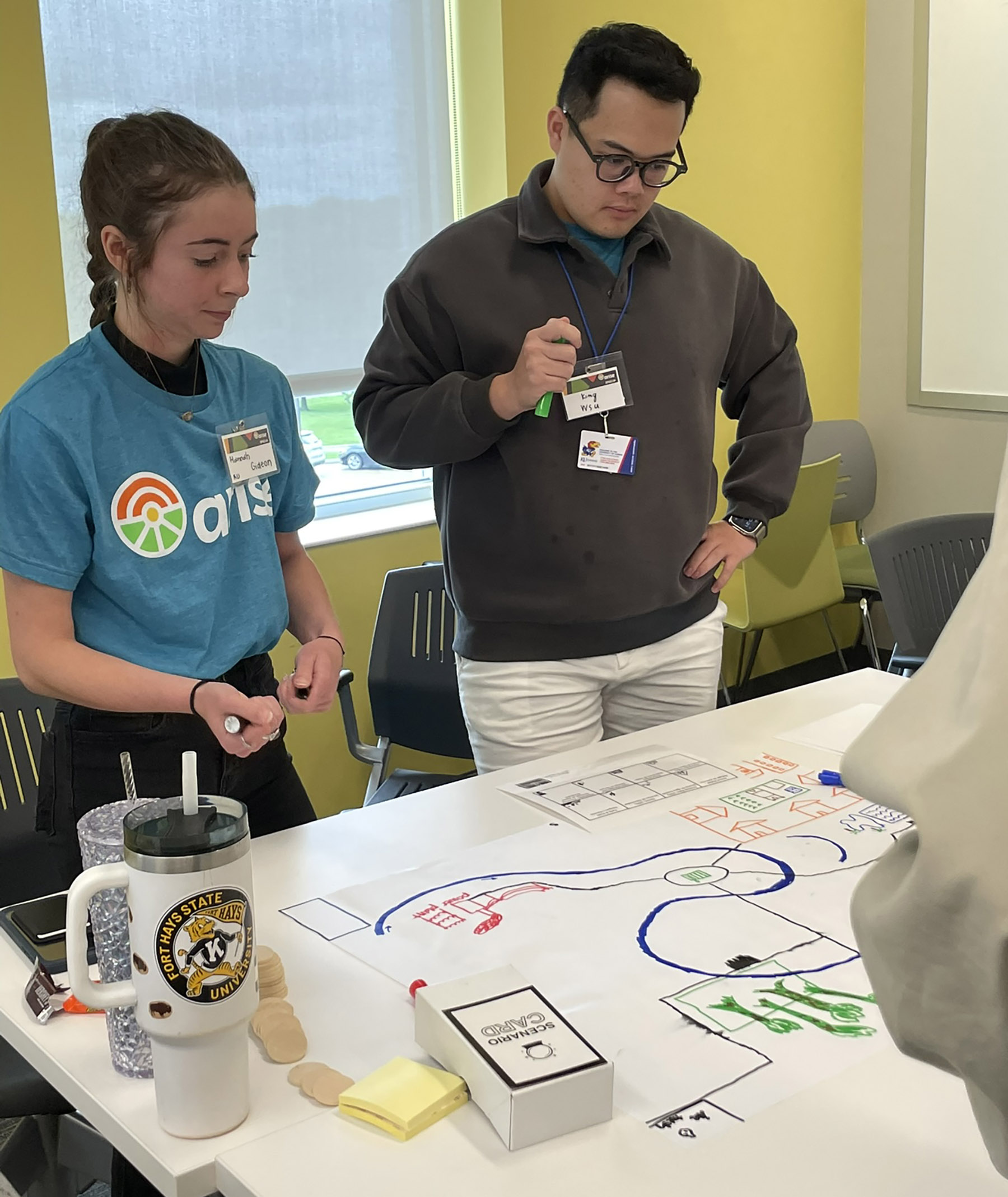
In this game, everybody is a city leader allocating resources for city services. Each town has eight departments: animal shelter, water, electrical, stormwater, street repair, trash management, parks and pools, and wastewater management.
After drawing their city with colorful markers, each player gets tokens to fund their city. They can earn more but also lose them—just like city budgets—with each card picked from the deck. Some years you're flush with cash after making a big deal that fills the coffers. Other years, there's a water main break, or never-ending snowfall, or a water tower to fix.
And, this being Kansas, natural disasters are always in the cards.
"It never fails that we have somebody that faces the tornado card, which is the most consequential card, within the first couple of turns of the year,” Colclazier said. “If you deal with a tornado in year 1, it constrains your budget so tightly that it's hard to bounce back later on."
Players do their best to budget city departments when tokens are low.
"All of the different age groups, even our younger groups, come to the consensus that the animal shelter would receive less resources, and would dedicate more towards streets, or infrastructure," Bronleewe said. But she added that the players always found ways to take care of the pets.
With limited budgets, players weigh different consequences to their funding choices to address other needs within the community. If they run out of money, the city fails and goes bankrupt. You lose!
The game plays out differently every time. It encourages questions and helps players understand the choices city leaders must make.
Secret Tunnels in City Infrastructure
"Engineers, quite literally, are shaping the societies we live in, in ways that high schoolers, or even your average people, aren't necessarily thinking about," said Meredith Morris-White. She directs undergraduate recruitment and outreach for the KU School of Engineering. When looking for new learning opportunities for the engineering camps, she was directed to ARISE and learned about the tabletop game.
Morris-White, who has a background in parks and recreation education, was intrigued by the game, "because engineering is so multi-faceted and broad, and a lot of students don't necessarily understand how engineering connects with the real world."
When she played it with 9th and 10th grade campers—74 in total—they had a blast. Students used a huge whiteboard wrapped around the room to create their towns.
"Some of them had very carefully thought out, well-plotted cities," Morris-White said, "and then one of them said, 'Mine's in the shape of a cat!'"
Other enterprising students chose to use their budgets to connect their towns with a secret tunnel.
Morris-White particularly enjoyed how the game’s playful fun led students to larger considerations.
“Coming from an experiential learning background, I know that these kinds of experiences can be so good for high schoolers, because it allows them to be creative in the way that they were when they were little kids," she said.
"They draw a city, name it whatever they want, and give themselves a secret tunnel with their neighbors. But they also have these really robust conversations about what does city infrastructure actually look like, and what connections can we make between the type of engineering they're interested in and what they've been doing all week, and how this city actually functions."
Next Steps
As EFC's senior program manager, Jeff Severin is always looking for ways to bring new research to Kansas communities.
"We're taking research that's at a point where it could be shared with communities, learn what they find most useful, and help them find ways to apply it." He said it was important to share information in layman's terms and create resources that could be used immediately. The game is one way to accomplish this.
Bronleewe added, "That's really what ARISE is about. How are we making decisions about how we spend our money, or how we prepare our communities for a new disaster?"
Colclazier has a personal stake in teaching resiliency. He grew up in Greensburg, Kansas, which was almost completely destroyed by a catastrophic EF5 tornado when he was 11 years old.
"That’s one of the great privileges of me working at the EFC," he said. "There is a human component to the work that we're doing, and that can lead to improved outcomes during times of great distress for communities, in terms of preparedness and in thinking about where the risks are within their community. That's something that I've really enjoyed as we enter this second phase of ARISE work -- being able to draw those connections for the citizens of those communities that it will then benefit."
Bronleewe agrees.
"One of our favorite things that we do as an EFC is develop and play this game with folks, because it is different every time. Folks always end up realizing it's not like you're learning something totally new, but it puts everything in a context that helps people be more aware of how these things work at a community level."
The team plans to continue hosting the role-playing game in the future. A slide-deck, directions sheet, and scenario cards are available in English and Spanish in digital format for printing upon request.
One piece of the puzzle
This game is just one way that ARISE is bridging the gap between research and practice to help Kansans become resilient to disasters. A host of other activities accompany this effort as part of the five-year ARISE initiative, which stands for Adaptive and Resilient Infrastructures driven by Social Equity.
ARISE is a major statewide initiative backed by the U.S. National Science Foundation (NSF) Established Program to Stimulate Competitive Research (EPSCoR) and the Kansas Board of Regents. Kansas NSF EPSCoR not only lays the groundwork for research in Kansas with projects like this, it also sparks workforce development in science and technology.
--Story by Melinda R. Cordell
Related links: